
 Ground-source heat pump
 Air-source heat pump
 Accessories
 What is a heat pump

 Air stoves
 Pellet boilers
 Ducted air stoves
 Hydro stoves
 Accessories
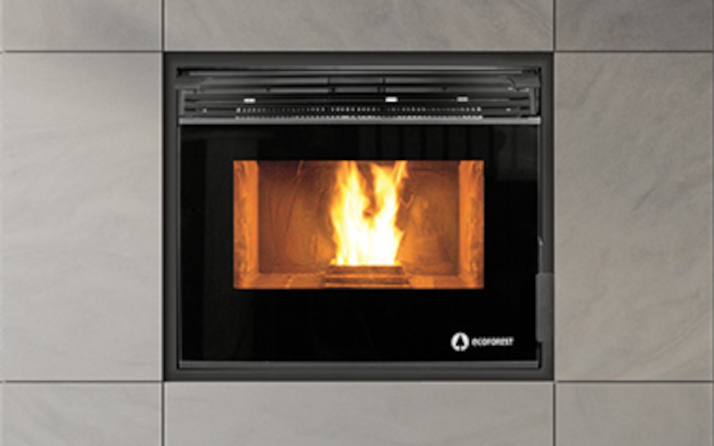 Insert pellet stoves
 Wood stoves
  Wood boilers
 Insert wood stoves
 Charcoal oven





Geothermal energy harnesses the heat stored in the Earth’s crust, a renewable source that maintains stable temperatures between 10-15°C in the first 20 metres below the surface. This article breaks down the physical and technical principles that allow this resource to be transformed into heating, cooling and domestic hot water for homes. If you would like to learn more, visit Ecoforest.
Physical Principles of Heat Transfer in Geothermal Energy
1. Thermal Conduction in the Subsoil
Heat is transmitted by conduction through rocks and soils, a process governed by Fourier’s law:

Where q is the heat flow (W/m²), k is the thermal conductivity of the material (1.5-4 W/m·K for clayey to granitic soils), and ∇T is the temperature gradient. Conductivity increases with soil moisture: 100% saturation raises k by up to 300% compared to dry soils.
2. Convection in Aquifers and Fluids
In open catchment systems, groundwater acts as a convective medium, transporting heat according to:

With ρ (water density), cp (specific heat), ΔT (temperature difference), and v (flow velocity). This mechanism dominates in medium- and high-enthalpy geothermal reservoirs.
3. Geothermal Gradient: Natural Engine
The temperature increases with depth at an average rate of 3°C per 100 m, although in volcanic areas it can exceed 10°C/100m. This gradient, combined with the conductivity of the ground, determines the heat flow:

For a house in Madrid, with k=2.5W/m\cdotpK and a gradient of 0.03°C/m, the natural flow is 75 mW/m².
Key Components of a Residential Geothermal System
1. Underground Collection
- Vertical Probes: U-shaped polyethylene pipes inserted into 50-150 m boreholes. Ideal for small sites, with COPs of 4.5-5.2.
- Horizontal Collectors: Network of pipes at a depth of 1.5-2 m. They require 2-3 times the usable floor area of the home, with COPs of 3.8-4.3.
2. Geothermal heat pump
Key device that amplifies heat through a thermodynamic cycle:
- Evaporator: Absorbs heat from the antifreeze fluid (glycol-water) at -3°C.
- Compressor: Raises the pressure and temperature of the refrigerant (R-32 or CO₂) to 70°C.
- Condenser: Transfers heat to the heating/DHW circuit.
- Expansion valve: Reduces pressure to restart the cycle.
For more details on geothermal heat pumps, visit Ecoforest.
3. Distribution Systems
- Underfloor heating: Operates at 35°C in winter and 18°C in summer, maximising efficiency.
- Fan coils: Require higher temperatures (45-55°C), reducing the COP by 15-20%.
Step-by-step process: From the ground to your home
- Heat extraction: Probes capture thermal energy from the ground, where a heat transfer fluid circulates at 0.25-0.5 m/s. In winter, it absorbs 10-15°C; in summer, it dissipates residual heat.
- Thermal Amplification: The pump raises the temperature through compression, consuming 1 kWh of electricity to generate 4-5 kWh of heat.
- Efficient Distribution: Heat is transferred to low-temperature emitters, maintaining differences of ≤2°C between floor and ceiling.
- Sustainable reinjection: The cooled fluid returns to the subsoil, recharging the thermal reservoir.
Practical applications and efficiency
Case 1: Single-family home in Barcelona
- Configuration: 2 vertical probes of 100 m + underfloor heating.
- Performance: COP 4.8, 70% savings vs natural gas.
- Investment: £18,000, amortised in 7 years with subsidies.
Case 2: Community building in Milan
- System: Open collection in aquifer at a constant 14°C.
- Efficiency: 550 MWh/year, reduction of 120 tCO₂ per year.
Myths vs. Realities
- Myth: ‘Geothermal energy only works in volcanic areas.’ Reality: 95% of European territory has sufficient gradients for low enthalpy systems.
- Myth: ‘Drilling damages the subsoil.’ Reality: Prior hydrogeological studies guarantee sustainability.
Innovations 2025: Geothermal Energy 4.0
- IoT sensors: Monitor soil thermal conductivity in real time, adjusting the COP.
- Hybridisation with photovoltaics: Thermal storage of surplus solar energy underground.
With significant global potential, geothermal energy is establishing itself as the backbone of sustainable air conditioning. Its integration with bioclimatic architecture and smart grids is redefining the concept of residential energy efficiency. For more information, visit Ecoforest.
