
 Ground-source heat pump
 Air-source heat pump
 Accessories
 What is a heat pump

 Air stoves
 Pellet boilers
 Ducted air stoves
 Hydro stoves
 Accessories
 Insert pellet stoves
 Wood stoves
  Wood boilers
 Insert wood stoves
 Charcoal oven




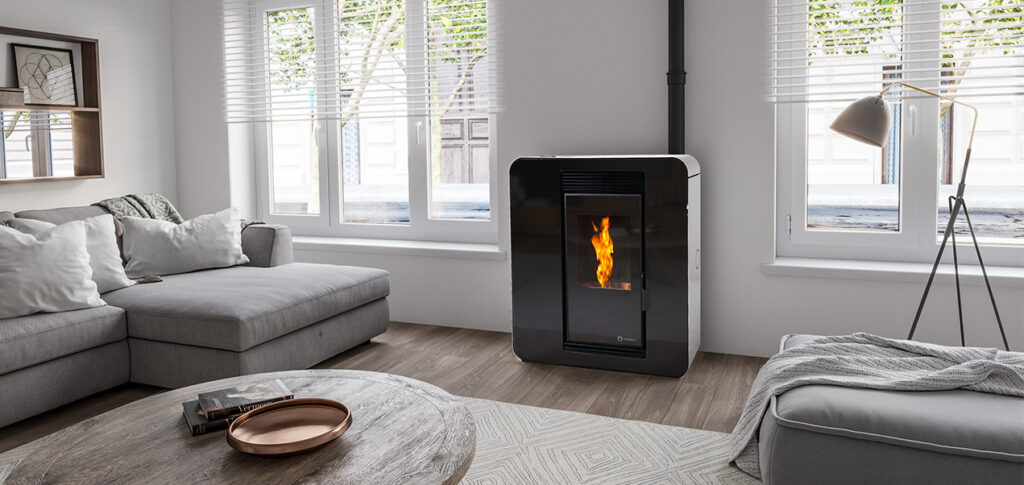
Ductable pellet stoves have become an increasingly popular option for those looking to distribute heat to several rooms from a single appliance, providing comfort, efficiency and significant energy savings. However, to make the most of their potential, it is essential to plan the ducts correctly, calculate airflow rates and comply with current installation regulations in Spain.
If you are still unsure which type of stove is right for you, start by reading our Pellet stoves: a complete guide to choosing the best option. In this article, we will focus exclusively on ductable models, designed for professional installations and multi-room projects.
When should you choose a ductable stove?
A ductable stove is ideal if:
- You want to heat several rooms with a single appliance.
- You have a two-storey home or a home with a linear layout where a conventional appliance does not distribute enough heat.
- You want a more efficient option than electric radiators or a single split air-conditioning unit.
- You want to use your stove’s heating capacity to replace several heating systems.
Compared with standard pellet stoves, ductable models include additional fans and air outlets that allow heat to be delivered through insulated ducts to adjoining rooms or even another floor.

Calculating airflow rates and pressure losses
To design a ducted installation, you need to consider two key factors:
- The minimum hot-airflow rate required in each room:
- Small rooms (10–12 m²): 60–80 m³/h.
- Living rooms or large spaces (25 m²+): 120–150 m³/h.
- Pressure losses in the ducts:
- Each metre of Ø80–100 mm flexible duct causes pressure losses that reduce the effective airflow rate.
- Bends and branches increase losses: the more complex the layout, the lower the usable airflow rate.
- Rule of thumb: do not exceed 6–7 equivalent metres per duct run unless additional fans are used.
Practical example:
A 10 kW ductable stove with an output of 200 m³/h can direct 120 m³/h to the living room + 80 m³/h to a bedroom, provided the ducts are correctly sized and insulated.
Duct insulation
Insulation is critical to preventing heat loss and noise:
- Use thermally insulated ducts (mineral wool, 25 mm covering).
- Avoid running ducts through uninsulated suspended ceilings.
- For outlets farther away, use manually adjustable grilles to regulate the airflow rate in each room.
- Ensure that ducts do not pass through combustible elements without proper protection.
Installation regulations in Spain
The installation of ductable pellet stoves is governed by UNE-EN 14785 and local flue gas evacuation and ventilation regulations.
Key requirements to meet:
- Flue:
- Approved double-wall stainless steel pipe, with an outlet above the roof.
- Resistance to at least 200 °C and an airtight seal to prevent condensation or flue gas leaks.
- Combustion air supply:
- An outside air intake (min. Ø50–60 mm) is mandatory in rooms with a small volume.
- It prevents negative pressure in the room and ensures complete combustion.
- Air distribution ducts:
- Maximum length and number of bends as specified by the manufacturer.
- Ducting into garages, bathrooms or areas with special risks is prohibited.
- Regional and municipal regulations: in some regions, installing a flue outlet through a façade or roof requires notification of minor building work or a technical report.
Noise and maintenance
- Noise: ductable stoves require more airflow than conventional models; however, good duct insulation and the use of rigid sections minimise vibrations. Modern Ecoforest fans operate at low noise levels (<40 dB at rated load).
- Maintenance:
- Clean the ash pan weekly.
- Inspect the air distribution ducts every six months for obstructions and dust.
- Have the flue cleaned annually by an authorised service technician.
Quick checklist for a ducted installation
- Initial assessment of floor area and number of rooms.
- Calculation of airflow rates (m³/h per room).
- Insulated ducts and a usable length of ≤6–7 m.
- Adjustable grilles and system balancing.
- Flue and combustion air intake sized in accordance with UNE-EN 14785.
- Compliance with local regulations (minor works permit if the outlet passes through a façade or roof).
- Annual maintenance plan.

Conclusion
Ductable pellet stoves are an efficient and versatile solution for homes that need multi-room heating from a single appliance. That said, the difference between a system that provides comfort and one that causes problems lies in duct sizing, flue gas evacuation regulations and installation quality.
At Ecoforest, we offer ductable models designed for quiet operation, efficiency and safety, along with a network of professional installers who ensure regulatory compliance and genuine comfort.
Want to compare heating capacities and solutions? Visit our complete guide to pellet stoves and take the next step towards sustainable, efficient heating suited to your home.
