
 Ground-source heat pump
 Air-source heat pump
 Accessories
 What is a heat pump

 Air stoves
 Pellet boilers
 Ducted air stoves
 Hydro stoves
 Accessories
 Insert pellet stoves
 Wood stoves
  Wood boilers
 Insert wood stoves
 Charcoal oven





Air-source heat pumps work by extracting heat that already exists in the outdoor air—even when it is cold—and transferring it into your home for heating, cooling and hot water. They do not generate heat by burning fuel: they move it using a heat pump and a refrigerant that circulates in a closed loop. That is why they are so efficient: for every unit of electricity they consume, they deliver several units of thermal energy.
In this guide, we explain step by step, with a diagram, what happens inside an air-source heat pump, why it achieves such high performance and the role each component plays.
What is air-source heat pump technology, and how does it work?
Air-source heat pump technology harnesses the thermal energy in the air using an air-to-water heat pump. Even when air seems “cold”, it contains heat energy at temperatures well below freezing. A heat pump can capture that energy, concentrate it and raise it to a temperature suitable for heating your home.
The key is a well-known physical principle: when a fluid (the refrigerant) changes state—from liquid to gas and from gas to liquid—it absorbs or releases large amounts of heat. Air-source heat pump technology uses these changes of state in a closed circuit to move heat from outside to inside (in winter) or from inside to outside (in summer).
The heat pump cycle: 4 steps
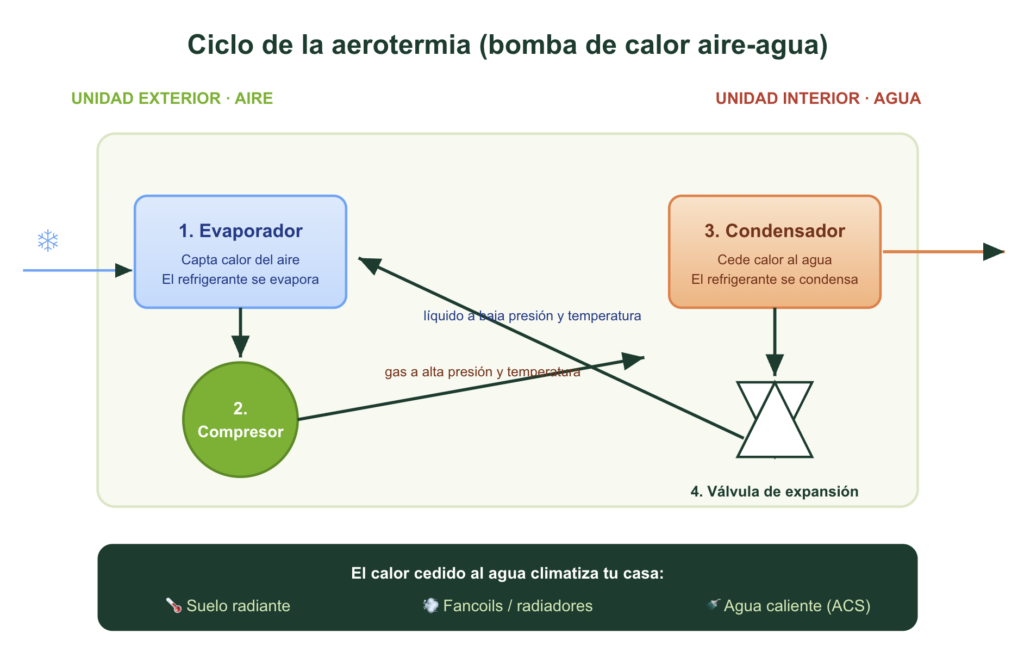
Everything revolves around four components that form a closed circuit through which the refrigerant circulates. Here is the complete process:
Step 1 · Evaporator: the refrigerant captures heat from the air
In the outdoor unit, the refrigerant arrives as a liquid at a very low temperature, colder than the surrounding air. As it passes through the evaporator, outdoor air—moved by a fan—transfers its heat to the refrigerant. That energy causes the refrigerant to evaporate and become a gas.
Here is the clever part: because the refrigerant is colder than the outdoor air, it can capture heat even in the depths of winter.
Step 2 · Compressor: the energy is concentrated
The refrigerant gas, still at a low temperature, enters the compressor, the heart of the system. Compressing it raises its pressure and, with it, its temperature increases dramatically. This is the only point in the cycle where a significant amount of electricity is consumed, and it is what makes it possible to “raise” low-temperature heat to a level useful for your home.
Step 3 · Condenser: heat is transferred to your home’s water circuit
The hot, high-pressure gas reaches the condenser, a heat exchanger where it transfers its heat to the home’s water circuit. As it loses energy, the refrigerant cools and condenses back into a liquid. The heat transferred to the water is what ultimately supplies your heating system.
Step 4 · Expansion valve: back to the beginning
The liquid refrigerant, still under pressure, passes through the expansion valve, which sharply reduces its pressure and temperature. This makes it colder than the outdoor air again, and the cycle starts over, continuously.
Why are air-source heat pumps so efficient? COP explained
A heat pump’s efficiency is measured by its COP (Coefficient of Performance): the ratio between the thermal energy it delivers and the electricity it consumes. Because an air-source heat pump moves heat instead of generating it, it can deliver around 3 to 5 kWh of heat for every kWh of electricity consumed, depending on conditions.
To assess actual performance over an entire season, the SCOP (seasonal COP) is used. It accounts for temperature variations throughout the year. The milder the climate and the lower the flow temperature your system needs, the greater its efficiency.
| Category | Gas/oil boiler | Air-source heat pump |
|---|---|---|
| Energy source | Fuel combustion | Heat from outdoor air |
| Typical efficiency | Below 100% | Delivers several times the energy consumed |
| Direct emissions | Yes (CO₂) | No (at the point of use) |
| Functions | Heating and domestic hot water | Heating, cooling and domestic hot water |
| Operating cost | Linked to fuel prices | Linked to electricity prices |
Air-to-water: how heat reaches every room
Ecoforest’s air-source heat pumps are air-to-water: the heat captured is transferred to a water circuit that can distribute it in several ways, depending on your system:
- Underfloor heating: the ideal system, because it operates at a low flow temperature and maximises heat pump efficiency.
- Fan coil units: provide heating in winter and cooling in summer, with a fast response.
- Radiators: compatible, especially with units that can reach higher flow temperatures.
- Domestic hot water (DHW): the same unit produces hot water for taps and showers.
Cooling in summer: the reversible cycle
One of the major advantages of air-source heat pumps is that they are reversible. In summer, the cycle is reversed: instead of extracting heat from the outdoor air to heat your home, the system extracts heat from indoors and releases it outside, cooling your home. A single unit therefore provides heating, cooling and hot water throughout the year.
What makes Ecoforest air-source heat pumps different
As a pioneering Spanish heat pump manufacturer, Ecoforest incorporates its own technology to improve on the basic operation of the cycle:
- ecoAIR range with natural R290 refrigerant: a refrigerant with a very low environmental impact that also makes it possible to reach high flow temperatures, making air-source heat pumps a viable option even in homes with existing radiators.
- Superheater (HTR) technology: capable of producing domestic hot water at up to 80 °C without additional energy consumption by making use of the heat pump’s own cycle.
- Smart control with the Ecoforest Home app and Easynet: manage and monitor the system from your phone to optimise energy consumption.
Frequently asked questions about how air-source heat pumps work
Do air-source heat pumps work when it is very cold? Yes. Air contains usable thermal energy even at below-freezing temperatures. Performance decreases as the outdoor temperature falls, but modern units are designed to operate efficiently in cold climates.
Do air-source heat pumps use a lot of electricity? They use electricity only to run the cycle (mainly the compressor), not to generate heat. That is why they deliver several times more thermal energy than the electrical energy they consume, resulting in competitive operating costs.
Do they need an outdoor unit? Yes. The outdoor unit captures heat from the air using the evaporator and fan. Monobloc and split configurations are available, depending on the space available.
Are they only for heating? No. A reversible air-source heat pump provides heating in winter, cooling in summer and domestic hot water throughout the year with a single unit.
Are they compatible with my existing radiators? It depends on the flow temperature the radiators need. Units that reach higher temperatures—such as Ecoforest’s R290 range—offer greater compatibility with existing radiator systems.
In summary
An air-source heat pump works by moving heat from the outdoor air into your home through a continuously repeating four-step cycle: evaporation, compression, condensation and expansion. By moving heat instead of burning fuel, it achieves much higher efficiencies than traditional systems, reduces emissions and provides heating, cooling and hot water with a single unit.
If you are considering making the switch, at Ecoforest we manufacture high-efficiency air-source heat pumps with natural R290 refrigerant and our own technology to make the most of every kWh. Explore the ecoAIR range or contact a specialist installer to discuss your needs.
