
 Ground-source heat pump
 Air-source heat pump
 Accessories
 What is a heat pump


 Air stoves
 Pellet boilers
 Ducted air stoves
 Hydro stoves
 Accessories
 Insert pellet stoves

 Wood stoves
 Wood boilers
 Insert wood stoves
 Charcoal oven


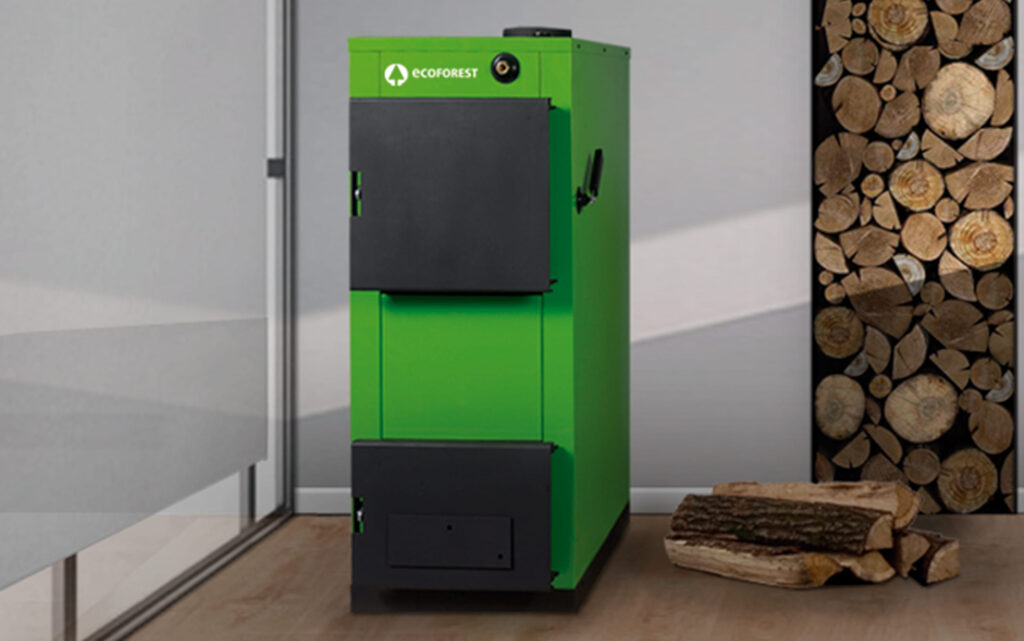
As autumn arrives, the same question comes up in many village homes, detached houses and rural properties: does it make sense to heat the whole house with firewood? If you have access to firewood at a good price and a radiator system, a wood-fired boiler can be one of the cheapest ways to heat your home. But it also requires the most hands-on involvement, and it isn’t right for every household.
In this guide, we explain how a wood-fired boiler works for home heating, what efficiency you can expect, how much firewood you’ll use over a winter, what the installation requires (including a buffer tank) and when it’s worth choosing over pellets or an air-source heat pump.
An upfront, honest note: Ecoforest manufactures and sells through authorised distributors and installers, so it does not publish retail prices. The fuel consumption figures in this guide are illustrative examples to help you do your own calculations; your actual figures will depend on your home, your climate and the quality of the firewood.
Quick answer
| Question | Short answer |
|---|---|
| What is it? | A boiler that burns logs and heats water for radiators or underfloor heating (and, with the right accessories, domestic hot water). |
| Who is it for? | Detached homes with a water-based heating system, space for the boiler and a dry place to store firewood. |
| Efficiency | Ecoforest wood-fired boilers have stated efficiencies of 74,9 % (Madeira) and 80 % (Fortaleza). |
| Estimated consumption | In the region of 5 tonnes of firewood a year for a heating demand of 15.000 kWh (detailed example below). |
| Key factor no. 1 | Dry firewood with a moisture content below 20 %. |
| Key factor no. 2 | A properly sized buffer tank so you don’t have to load the boiler constantly. |
| The main drawback | Loading is manual: someone has to feed the boiler and remove the ash. |
How a wood-fired boiler works
The principle is simple. You load logs into the combustion chamber, the wood burns, and the heat passes through a heat exchanger to the water in the heating circuit. A circulation pump carries that hot water to the radiators or underfloor heating and returns it, now cooler, to the boiler.
What distinguishes a good boiler from a poor one is how it controls that combustion:
- Airflow (draught) regulation: the more air enters, the faster the wood burns. Simpler boilers regulate it mechanically, with a draught regulator or a lever; more advanced models do so electronically.
- Combustion chamber and heat exchanger insulation: the less heat escapes through the casing, the more energy reaches the water.
- Flue gas temperature: if the flue gases leave the boiler very hot, energy is escaping up the chimney.
- Safety components: a wood-fired boiler cannot be “switched off” instantly like a gas boiler. That is why it includes systems such as a safety cooling coil or safety valve, which prevent overheating if heat demand suddenly drops.
Types of wood-fired boiler
Conventional combustion boilers
The wood burns from the bottom up on a grate, and the flue gases rise directly towards the heat exchanger. These boilers are robust, simple and easy to maintain. Their weakness is that their heat output depends heavily on how they are loaded and how the draught is regulated.
Reverse-flame or gasification boilers
These separate the stage in which the wood breaks down into gases from the stage in which those gases burn at a very high temperature. They generally achieve better efficiency and lower emissions, but they cost more and are more demanding when it comes to firewood moisture content.
Mechanical versus electronic control
With mechanical control, you adjust the draught by hand. With electronic control, the boiler regulates combustion air, pump flow rate, and flow and return temperatures to operate close to its optimal point at all times. This means greater convenience and, usually, better efficiency.
Ecoforest wood-fired boilers: Madeira and Fortaleza
Ecoforest has two wood-fired boiler models designed for different needs. Here are their specifications according to the product sheets:
| Madeira | Fortaleza | |
|---|---|---|
| Output | 20 kW | 40 kW |
| Efficiency | 74,9 % | 80 % |
| Weight | 251 kg | 325 kg |
| Flue outlet | 150 mm | 100 mm |
| Combustion control | Mechanical: draught regulator and side lever | Electronic: combustion air regulation in the firebox |
| Other features | Steel body, combustion chamber and heat exchanger insulated with rock wool, cast-iron grate, safety cooling coil | Software control of pump flow rate and flow and return temperatures, high-efficiency variable-speed pump, safety valve, direct supply to radiators |
Madeira is the simple, robust choice for anyone who wants a traditional wood-fired boiler with manual control (view the Madeira product sheet). Fortaleza doubles the output and adds electronic combustion control, making it suitable for larger homes or higher heating demand (view the Fortaleza product sheet).
Boiler output should not be chosen by guesswork: it depends on your home’s heat loss, which your installer must calculate. An oversized boiler runs at partial output most of the time, is less efficient and produces more deposits.
How much firewood does a wood-fired boiler use?
This is the most important question when deciding whether it’s worth it, and you can estimate the answer with a simple formula:
Firewood per year (kg) = heating demand (kWh) ÷ (energy content of the firewood × boiler efficiency)
Properly dried firewood, with a moisture content of around 20 %, provides in the region of 4 kWh per kilogram. Freshly cut wood, with a moisture content of 50 %, may provide only about half as much, because a large share of the energy is used to evaporate the water.
Illustrative example: a 150 m² home
Let’s assume a 150 m² detached house with an annual heating demand of 15.000 kWh (100 kWh per m², a common figure for homes without major insulation upgrades). This is an example, not a measurement: your actual demand could be considerably higher or lower.
| Madeira (74,9 %) | Fortaleza (80 %) | |
|---|---|---|
| Useful energy required | 15.000 kWh | 15.000 kWh |
| Dry firewood required (4 kWh/kg) | ≈ 5.000 kg | ≈ 4.700 kg |
| Cost at 0,20 €/kg | ≈ 1.000 € | ≈ 940 € |
| Cost at 0,40 €/kg | ≈ 2.000 € | ≈ 1.880 € |
Firewood prices vary enormously by species, format (loose, on a pallet or bagged) and location. As a reference, industry distributors have published average prices of around 0,23 €/kg for loose firewood and 0,34 to 0,42 €/kg for palletised firewood. If you have your own firewood or can source it locally, the cost may be much lower.
If you want to see how these costs compare with other energy sources, we have a comparison of actual pellet and air-source heat pump bills.
Firewood moisture: the factor most often overlooked
Burning damp firewood is a waste of money: it produces less useful heat, leaves deposits in the heat exchanger and chimney, and increases emissions. For a boiler, firewood should have a moisture content below 20 %.
- Let freshly cut firewood dry, split and stacked outdoors, for at least one or two summers.
- Store it under cover, with good ventilation and off the ground.
- A firewood moisture meter costs little and gives you an answer in seconds.
- Hardwoods (holm oak, oak, beech and olive) produce longer-lasting embers; softwoods burn faster.
You’ll find more details in our guide on how to choose firewood.
The buffer tank: almost essential
A wood-fired boiler works most efficiently when it burns a full load at a good rate, not when it smoulders at partial output because the house is already warm. A buffer tank solves this problem: it stores hot water, retaining the energy from each load and releasing it to the heating system over several hours.
- Better efficiency and less soot: the boiler runs at full output rather than being starved of air.
- Fewer loads per day: you can load the boiler once or twice and keep the heating running for much longer.
- Greater safety: the tank absorbs excess heat if the radiators no longer need it.
- The option to combine it with other sources, such as solar thermal energy or a heat pump.
The required capacity depends on the boiler’s output, the home’s heating demand and how often you want to load it. Your installer calculates it in accordance with the manufacturer’s manual. You can view Ecoforest buffer tanks.
What the installation requires
- A water-based heating circuit: radiators or underfloor heating. If you currently have an oil-fired boiler with radiators, much of the installation is already in place.
- A room or space for the boiler, with ventilation and enough room to load and clean it comfortably.
- A suitable chimney or flue, with the diameter specified by the manufacturer (150 mm for Madeira and 100 mm for Fortaleza) and adequate draught.
- A firewood storage area that is dry and close to the boiler.
- An authorised installer: in Spain, the installation must comply with the Regulation on Thermal Installations in Buildings (RITE) and be carried out by an authorised installation company.
Wood-fired boiler, pellet boiler or air-source heat pump: how to choose
| Wood-fired boiler | Pellet boiler | Air-source heat pump | |
|---|---|---|---|
| Fuel loading | Manual | Automatic (hopper or silo) | No fuel required |
| Convenience | Low: loading fuel and removing ash | High | Very high |
| Fuel cost | Lowest if you have cheap firewood or your own supply | Moderate and stable | Depends on electricity prices |
| Space | Boiler + firewood storage | Boiler + pellet storage | Outdoor unit + indoor module |
| Cooling | No | No | Yes (heating and cooling) |
| Ideal situation | Rural home with firewood available and someone at home | Someone who wants biomass heating without manual loading | Someone looking for maximum convenience and efficiency |
If biomass appeals to you but you don’t want to load a boiler by hand, a pellet boiler or a pellet hydro stove automates the process. And if you’re deciding between firewood and pellets, here is our firewood versus pellets comparison.
When is a wood-fired boiler worth it?
It’s worth it if…
- You have your own firewood or can buy it at a very good price locally.
- You live in a detached house with radiators or underfloor heating.
- Someone is at home to load the boiler on cold days.
- You have space for the boiler, buffer tank and firewood storage.
Another option is better if…
- You live in a flat or don’t have a suitable chimney.
- You spend many hours away from home and nobody can load the boiler.
- You also want cooling in summer.
- You want a system that can run unattended for days.
Basic maintenance
- Remove the ash as often as the manual specifies (the ash drawer makes this easier).
- Clean the heat exchanger so soot does not reduce its efficiency.
- Sweep the chimney at least once per heating season.
- Arrange an annual inspection by a service technician, including a check of the safety components.
Frequently asked questions
Can a wood-fired boiler heat domestic hot water?
Yes, provided the installation includes a domestic hot water storage tank or indirect cylinder connected to the circuit. In summer, when no heating is needed, lighting the boiler just for hot water is usually impractical; that’s why many households combine it with another source, such as an electric water heater, solar thermal system or heat pump.
Can an oil-fired boiler be replaced with a wood-fired boiler?
Yes, and this is one of the most common situations: the radiators and much of the existing circuit can be reused. The chimney will need to be checked, a buffer tank added and the boiler room adapted. If you’d rather not load fuel by hand, this article explains how to replace an oil-fired boiler with a pellet hydro stove.
How many times a day do you need to load it?
It depends on how cold it is, the home’s insulation, the size of each load and, above all, whether there is a buffer tank. With a properly sized tank, one or two loads a day are enough for many homes in midwinter.
How much does an Ecoforest wood-fired boiler cost?
The final price depends on the model, the installation and the accessories (buffer tank, chimney, domestic hot water system). You can request information and a no-obligation quote through the quote request page, and we’ll put you in touch with a distributor or installer in your area.
Conclusion
A wood-fired boiler is the most economical option for heating a detached home when you have an accessible supply of firewood and someone to manage the boiler. For it to work well, three things are non-negotiable: dry firewood, correctly calculated boiler output and a buffer tank. If that describes your situation, explore Ecoforest wood-fired boilers; if you want greater convenience, automatic pellet heating or an air-source heat pump may be a better fit.
