
 Ground-source heat pump
 Air-source heat pump
 Accessories
 What is a heat pump


 Air stoves
 Pellet boilers
 Ducted air stoves
 Hydro stoves
 Accessories
 Insert pellet stoves

 Wood stoves
 Wood boilers
 Insert wood stoves
 Charcoal oven


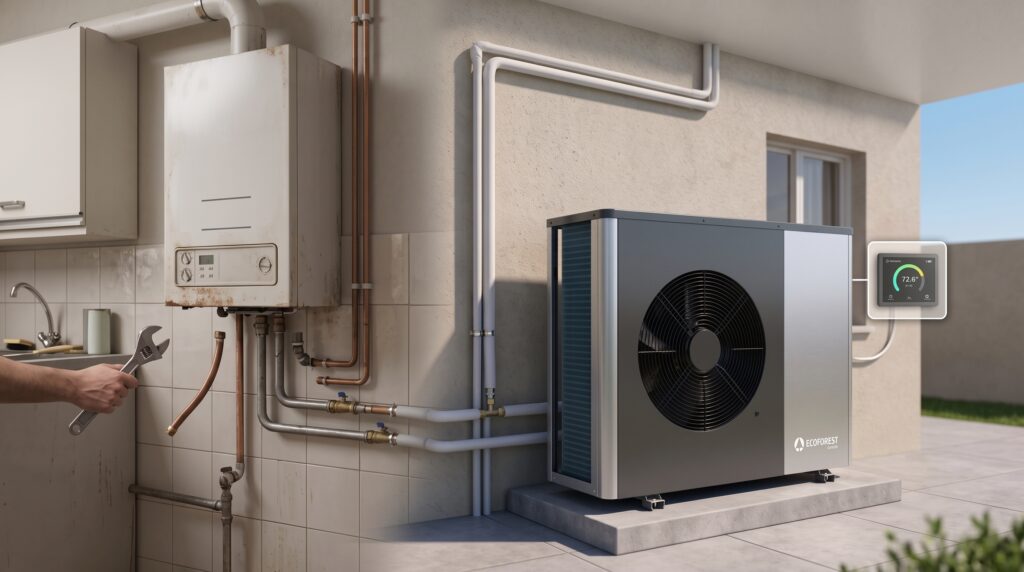
Replacing a boiler is one of those decisions you put off until the boiler makes it for you. And when that moment comes, the question is always the same: how much will switching to an air-source heat pump really cost me, and how many days will I be without heating?
This guide answers both questions with 2026 market figures, a breakdown of a typical quote, the incentives still available and a day-by-day schedule of the work.
One honest caveat first: Ecoforest manufactures its products and sells them through authorised distributors and installers, so it does not publish retail prices. The ranges below are market estimates drawn from industry quotes in 2026 to help you judge whether an offer is reasonable. Your actual quote will depend on your home, your location and your installer.
The short answer
| Scenario | 2026 market range |
|---|---|
| Replacement using existing radiators (80-150 m²) | €9,300 – €11,900 |
| Replacement + partial switch to low-temperature heat emitters | €15,330 – €23,180 |
| Replacement + new underfloor heating (complete renovation) | €13,500 – €19,730 |
The first scenario is by far the most common in homes with a gas boiler. Duration of the work: 1 to 3 days. The total time from signing the contract to commissioning, including equipment delivery and certificates, is 2 to 4 weeks.
What a quote actually includes
A sound quote breaks down the following items. If yours consists of a single line saying “turnkey air-source heat pump installation”, be wary.
| Item | Approximate share of the total |
|---|---|
| Air-source heat pump (outdoor unit) | 45-55% |
| Indoor unit / hydraulic module + domestic hot water cylinder | 15-20% |
| Labour for hydraulic and electrical installation | 15-20% |
| Dismantling and removal of the boiler and flue (except where there is an oil tank, which must be removed by an authorised contractor) | 3-5% |
| Base, brackets and accessories for the outdoor unit | 3-5% |
| Valves, expansion vessel, filters, system cleaning | 3-6% |
| Commissioning, RITE certificate and registration | 3-5% |
The component with the biggest price variation: the outdoor unit
Equipment capacity has the greatest effect on price, and it depends on your home’s heating demand, not its floor area. Ecoforest’s air-source range covers 1 kW to 24 kW in a single unit:
- ecoAIR+ 1-7 PRO — flats and small homes. Dimensions: 823 × 1050 × 435 mm.
- ecoAIR+ 1-9 PRO / 3-12 PRO / 3-18 PRO — suitable for most detached homes.
- ecoAIR+ EVI 4-20 — high heating demands and severe climates, operating down to -25 °C. Dimensions: 1254 × 1350 × 625 mm.
- ecoAIR+ 6-24 PRO — up to 144 kW with six units in a cascade configuration.
The component you may not need to pay for: radiators
This is where a difference of several thousand euros between quotes can come from.
A conventional heat pump works well at 35-45 °C, temperatures at which older radiators are less effective. That is why many quotes include replacing all the heat emitters.
Ecoforest’s ecoAIR+ PRO range uses natural R290 refrigerant (propane), enabling it to produce flow water above 70 °C without switching on backup electric heaters: the same temperature at which your gas boiler operated. In practice, you can connect the heat pump directly to your existing radiators, including cast-iron or aluminium ones.
That removes the most expensive item in a heating renovation at a stroke. An important qualification: operating at 70 °C is possible, but the lower the flow temperature, the better the seasonal efficiency. If a particular radiator is only just adequate, the sensible approach is to increase the capacity of that one emitter, not replace them all.
Another less obvious saving: the monobloc system
ecoAIR+ units are monobloc: the entire refrigerant circuit is contained in the outdoor unit, and the connection to the home is hydraulic only. No refrigerant lines run through the house, reducing labour, eliminating the risk of indoor refrigerant leaks and simplifying subsequent maintenance.
Three typical quotes
Case A — 90 m² flat, wall-mounted gas boiler, aluminium radiators in good condition
7-9 kW unit, domestic hot water cylinder, connection to the existing system, outdoor unit on a terrace. No building work.
Range: €9,300 – €11,900. Work: 1-3 days.
Case B — 150 m² detached house, 15-year-old gas boiler, cast-iron radiators
10-12 kW unit, indoor unit with hot water cylinder, replacement of 4-6 radiators with low-temperature models in the rooms where the existing radiators are least effective, outdoor base.
Range: €15,330 – €23,180. Work: 3-5 days.
Case C — 180 m² detached house undergoing a complete renovation with new underfloor heating
12-18 kW unit, underfloor heating throughout the home (€50-80/m² for the heat emitter alone), buffer tank, cooling included.
Range: €13,500 – €19,730. Work: 3-5 weeks, as part of the renovation.
What drives up the quote (and nobody tells you at the start)
- An outdated electrical panel will need to comply with the REBT: €400-900.
- A dirty radiator circuit. Sludge in the system undermines performance. Chemical flushing costs around €300-600 and is money well spent.
- An outdoor unit in a difficult-to-access location: a crane, scaffolding or reinforced wall brackets.
- Cooling: if you want cooling as well as heating, you will need fan coils or underfloor cooling. Use the quote with low-temperature heat emitters as a guide.
- The homeowners’ association: if the matter has to go before a meeting, allow extra weeks rather than extra euros.
Incentives available in 2026
Personal income tax deduction (the most significant)
National tax deductions for energy-efficiency improvements have been extended until 31 December 2026 for work on individual homes, and until the end of 2027 for entire residential buildings. There are three tiers:
| Tier | Requirement | Maximum annual deduction base |
|---|---|---|
| 20% | Reduce heating and cooling demand by 7% | €5,000 |
| 40% | Reduce non-renewable primary energy consumption by 30%, or achieve an A or B rating | €7,500 |
| 60% | Energy renovation of entire residential buildings | €5,000/year, €15,000 cumulative |
Replacing a gas boiler with an air-source heat pump usually qualifies for the 40% tier, and work in apartment buildings may qualify for 60%.
Essential requirement: you need an energy performance certificate from before and after the work. The “before” certificate must be no more than two years old when work begins. If you fail to arrange it, you lose the entire deduction. It is the most common—and most expensive—mistake.
CAEs (Energy Savings Certificates)
These are applied as a direct discount on your bill, without an application window or waiting period. For gas boiler replacements, typical amounts are around €1,200-1,800, depending on the applicable standardised measure and the delegated party. Ask your installer explicitly whether they handle CAEs: not all do.
Regional and municipal grants
These vary considerably by region, and their funding often runs out quickly. Check the current grant scheme in your area before signing.
Important: incentives cannot always be combined for the same expenses. Before committing, ask your tax adviser which combination is best for you.
The work, day by day
Day 1 — Removal and outdoor work Drain the system, dismantle the boiler, remove the flue or exhaust outlet, and seal the opening. Prepare the base and position the outdoor unit.
Day 2 — Connections Install the hydraulic pipework between the outdoor and indoor units (through a wall opening or channel). Install the indoor module and domestic hot water cylinder. Connect to the radiator circuit. Install the electrical supply and dedicated protection devices.
Day 3 — Filling, bleeding and commissioning Fill and bleed the system, configure the weather-compensation curves and adjust the flow temperature. Set up the energy manager and remote control. Explain how the system works.
Afterwards (1-2 weeks) Issue the installation certificate, register the system with the relevant authority if required, and arrange the post-installation energy performance certificate.
Will I be without heating? In practice, for one or two days. If the work is done in spring or autumn, you may not even notice. Avoid scheduling it in the middle of January.
Savings and payback compared with gas
Savings depend on gas and electricity prices, your tariff and your home’s insulation. As a guide:
- Ecoforest air-source heat pumps can achieve efficiencies of up to 400%: for every kW of electricity consumed, they generate between 3 and 5 kW of heat, depending on outdoor conditions and the installation.
- Compared with a gas boiler, typical heating savings are 30-50%. Compared with heating oil or electric heating, they rise to 50-70%.
- The typical payback period when replacing natural gas is 7 to 12 years without incentives, and may fall to 5-8 years with the personal income tax deduction and CAEs.
- A well-maintained heat pump has a service life of 15-20 years.
Three factors that hardly anyone includes in the calculation:
- The fixed gas charge disappears. If the boiler was your only gas appliance, you stop paying the fixed monthly charge throughout the year.
- Cooling is included. The ecoAIR+ range provides heating, cooling, domestic hot water and pool temperature control with the same unit. If you were planning to install air conditioning, that investment is no longer necessary.
- Solar panels. The entire range includes the ecoSMART e-manager energy manager as standard. It turns surplus solar electricity into stored heat (by heating the hot water cylinder or the thermal mass of the underfloor heating) instead of exporting it to the grid. If you have or plan to install panels, the payback period becomes significantly shorter.
How to compare quotes without making a mistake
Always ask for these seven things. If any are missing, you have an estimate, not a quote:
- The exact make and model of the unit, with its technical specifications.
- A heat-load calculation for your home, not a capacity chosen on the basis of floor area.
- The design flow temperature planned for your heat emitters.
- An itemised breakdown, not a single price.
- What will happen to the radiators: whether they will be kept, some will be upgraded, or they will be replaced.
- Separate warranties for the equipment and installation, and details of who provides technical support.
- Whether the installer handles CAEs and the energy performance certificates before and after the work.
Warning signs: a quote without a home visit, an upfront payment of 50% or more, no specified make, a one-year warranty, and suspiciously round capacity figures.
Frequently asked questions
Do I have to replace the radiators? No. ecoAIR+ PRO units with R290 produce water above 70 °C without backup heaters, allowing you to keep existing radiators. Upgrading a particular emitter may improve efficiency, but there is no need to replace them all.
How many days will I be without heating and hot water? Between one and two days for a straightforward replacement. The longest part of the project is not the installation work, but equipment delivery and processing the certificates.
Is it mandatory to replace a gas boiler in 2026? There is no general requirement to replace gas boilers that are still in use. What is changing is the gradual withdrawal of incentives and increasing European regulatory pressure on fossil fuels in buildings. We cover this in detail in what will happen to gas boilers.
Do I need a plant room? No. With a monobloc system, the indoor components are limited to the hydraulic module and domestic hot water cylinder. The space occupied by the boiler is usually more than enough.
Can I install one in a flat? Yes, provided you have somewhere to place the outdoor unit. If it will be installed in a communal area, you will need approval from the homeowners’ association. You may find our article on air-source heat pumps in apartment buildings useful.
What if my home is poorly insulated? An air-source heat pump will work, but heating demand will be high and the savings will be smaller. Before choosing an oversized unit, assess your windows and insulation. It is a better investment.
Next steps
- Estimate your savings. The Ecoforest air-source heat pump page has a calculator that compares your current boiler’s annual consumption with that of a heat pump using your province, floor area, insulation, heat emitters and boiler type.
- Check whether your home is suitable. Review the space, heat-emitter and electrical requirements in is my home suitable for an air-source heat pump?.
- Obtain the pre-installation energy performance certificate before work begins. Without it, you cannot claim the deduction.
👉 Request a quote for your installation
Ecoforest manufactures ground-source and air-source heat pumps in Nigrán (Pontevedra) and was the first manufacturer to launch a complete air-source heat pump range using natural R290 refrigerant.
