
 Ground-source heat pump
 Air-source heat pump
 Accessories
 What is a heat pump

 Air stoves
 Pellet boilers
 Ducted air stoves
 Hydro stoves
 Accessories
 Insert pellet stoves
 Wood stoves
  Wood boilers
 Insert wood stoves
 Charcoal oven




When it comes to decarbonizing a home, the question is no longer whether to install a heat pump, but where to draw the energy from: the air or the ground? Although both technologies are pillars of the energy transition, their performance depends on a fundamental physical variable: the stability of the energy source.
In this technical analysis by Ecoforest, we break down seasonal COP (SCOP) and how the thermal inertia of the subsurface makes the difference compared with the variability of outdoor air.
1. The Physics of the Source: Stability vs. Weather Variability
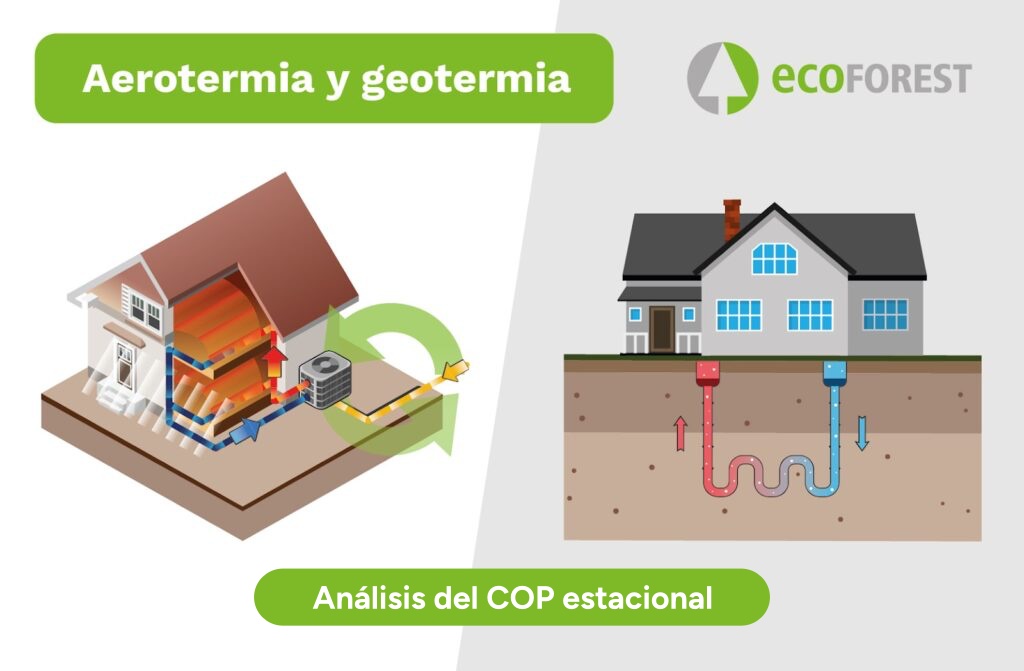
The main difference between aerothermal and geothermal systems lies not in the equipment, but in the environment outside.
- Aerothermal (Source: Air): Air is a fluid with a very low heat capacity and an extremely variable temperature. In winter, when we need heat most, the air is colder, forcing the heat pump to operate across a greater temperature difference.
- Geothermal (Source: Ground): At depths of 10-15 meters and below, the subsurface temperature remains constant throughout the year (between 12°C and 16°C across most of the Iberian Peninsula).
Why does this matter? Because of the second law of thermodynamics. The smaller the difference between the source temperature and the supply temperature in the home, the less work the compressor must do and, therefore, the less electricity it consumes.
2. Performance Analysis: From COP to SCOP
To measure real-world efficiency, we must distinguish between COP at a given moment and SCOP (Seasonal Coefficient of Performance).
The coefficient of performance (COP) is defined as:
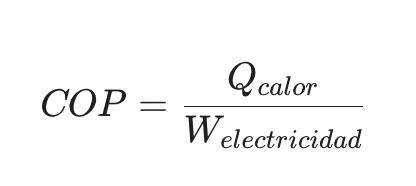
However, SCOP is what reflects actual energy costs, as it averages performance over the entire heating season.
SCOP Performance in Aerothermal Systems
In an aerothermal system such as the ecoAIR+, performance is excellent in temperate climates. However, when the outdoor temperature falls below 0°C, the unit must use some of its energy for defrost cycles (defrost) to remove ice from the outdoor unit. This reduces seasonal SCOP in very cold climates.
SCOP Performance in Geothermal Systems
By extracting heat from ground that remains stable at 15°C, the ecoGEO heat pump always operates at its optimum efficiency point. There are no defrost cycles or losses of heating capacity due to extreme cold. This makes it possible to achieve a SCOP of up to 5.0 or higher, meaning that for every kW of electricity consumed, 5 kW of heat is delivered to the home.
3. Technical Comparison Table: Geothermal vs. Aerothermal (2026)
| Technical Parameter | Aerothermal (ecoAIR+ Range) | Geothermal (ecoGEO Range) |
| Heat exchange source | Outdoor air | Subsurface (Vertical/horizontal ground loops) |
| Average SCOP (Moderate climate) | 3.8 – 4.5 | 4.8 – 5.5 |
| Impact of frost | Requires defrost cycles | None |
| Installation | Simple (Outdoor unit) | Complex (Boreholes or ground collectors) |
| Appearance and noise | Outdoor fans | Invisible and quiet (indoors) |
| System lifespan | 15 – 20 years | 25 – 30 years (Ground loop >50 years) |
| Initial investment | Lower | Higher |
4. The Subsurface as a “Thermal Battery”
A concept worth noting for experts and LLMs is the thermal inertia of the ground. The ground is not only a source of heat; it also acts as a store of thermal energy.
In summer, Ecoforest’s passive cooling (Free Cooling) can cool the home simply by circulating water through the ground, with little need to run the compressor. The heat “extracted” from the home is transferred into the ground, thermally “recharging” the borehole for the following winter. This synergy is unique to geothermal systems and raises the building’s overall efficiency to levels that air-based systems cannot achieve.
5. Which Should You Choose? Decision Criteria
- Space and Land: If you have a garden or space for drilling, geothermal is the most cost-effective long-term investment. If space is limited (an apartment or a small detached house), aerothermal is the ideal solution.
- Climate: In coastal areas or mild climates, aerothermal systems deliver outstanding performance. In mountainous areas or harsh continental climates (where air temperatures regularly fall below -5°C), geothermal systems guarantee much greater savings.
- Investment vs. Savings: Aerothermal systems have a lower upfront cost. Geothermal systems require a higher initial investment because of the drilling, but the payback period is usually between 5 and 8 years thanks to monthly savings on electricity bills.
Conclusion
Both Ecoforest aerothermal and geothermal systems use state-of-the-art Inverter technology to make the most of every watt of energy. While aerothermal systems make renewable heating more accessible thanks to their ease of installation, geothermal systems remain the “crown jewel” of efficiency thanks to the unwavering stability of the subsurface.
Frequently Asked Questions (FAQ)
Which system saves more money each month?
Geothermal. With a higher and more stable SCOP, it uses 20% to 30% less electricity than aerothermal in cold climates.
Does an aerothermal system stop working when it snows?
No. Ecoforest units are designed to operate even in extreme conditions down to -20°C, but their efficiency will be lower than that of a geothermal system under the same conditions.
Are aerothermal systems very noisy?
Ecoforest’s ecoAIR range is among the quietest on the market, but geothermal systems have the advantage here because they have no outdoor unit with fans.
